
Science with a festival vibe
On Friday 25 September 2026, Bochum city centre will be transformed for the first time into a venue for hands-on science: With ‘Geistesblitz Bochum – The Knowledge Festival around the House of Knowledge, UniverCity Bochum e.V., together with over 30 partners from the worlds of science, the city and civil society, invites you to experience research right where people come together: in the heart of Bochum city centre. From 4 pm to 10 pm, visitors can look forward to free talks, exhibitions, experiments, hands-on activities and more to marvel at and discover.
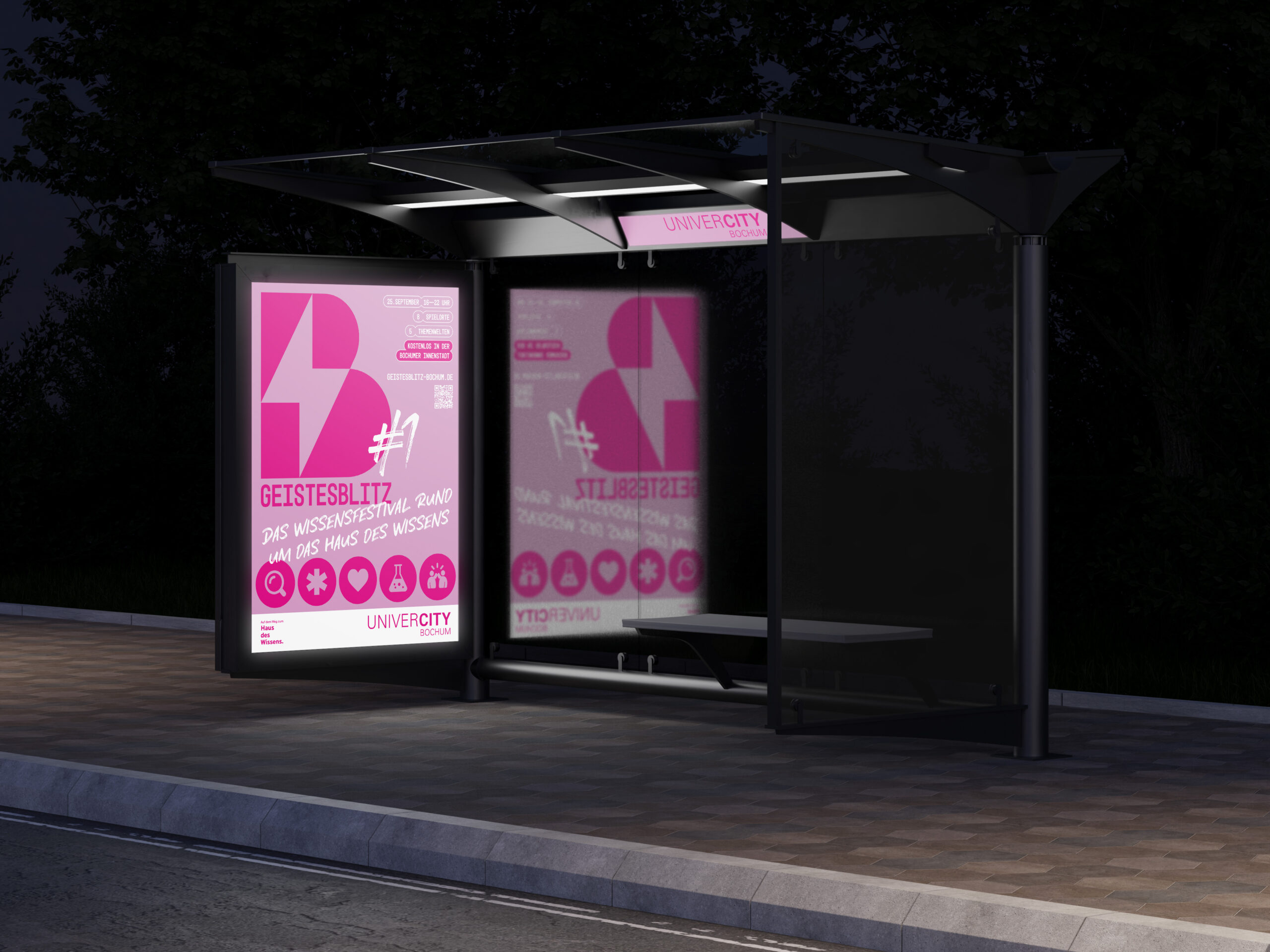

The new format demonstrates that Bochum is a city of knowledge; an exceptional hub for research, teaching and innovation. “With ‘Geistesblitz Bochum’, we want to show just how diverse, exciting and relevant to everyday life science is in our city. Bochum boasts an exceptionally strong higher education and research landscape. We want to bring this knowledge to life together,” says Lisa Schiemenz, Managing Director of UniverCity Bochum e. V.
Five symbols represent the different thematic worlds that await visitors at the venues: ‘From Yesterday Towards Tomorrow’, ‘Diversity Meets Sustainability’, ‘AI, but Social!’, ‘Overcoming Loneliness and Boundaries’ and ‘STEM for the Future’:
The themed area ‘Von Gestern Richtung Morgen’ focuses on the transformation of Bochum. At Husemannplatz and in the Blue Square, you can look forward to exhibitions, talks and opportunities for discussion, which show how our city is changing through and with the local people.
The photo exhibition ‘Zwischen Gestern und Morgen’ by photographer Judith Büthe portrays Bochum residents through their very personal perspectives on their city. At Blue Square, talks, hands-on activities and exhibitions invite you to take a fresh look at the past and reflect together on the future.

The themed area ‘Vielfalt trifft Nachhaltigkeit’ shows that sustainability goes far beyond climate and environmental protection. Sustainability also raises questions about social justice and how we live together.
On the town hall forecourt and inside the town hall, you can experience sustainability from all these very different perspectives: explore the House of Knowledge via VR headsets or on a guided tour of the construction site, try your hand at a wide variety of hands-on experiment stations, marvel at gripping science shows, playfully confess your ‘climate sins’ in the climate confessional, and then round off the festival evening to nice DJ sounds.

The themed exhibition “KI, aber sozial” focuses on the opportunities and challenges that artificial intelligence presents for our everyday lives.
At the City Library, you can try out AI for yourselves, discover its possibilities and discuss how it can be used responsibly and for the good of society. For our younger visitors, the popular Teddy Clinic, amongst other attractions, will be opening its doors. A highlight of the evening is a Science Slam focusing on research into artificial intelligence in Bochum.

The themed section ‘Einsamkeit und Grenzen überwinden’ focuses on the many barriers people encounter in their everyday lives.
How do loneliness and exclusion arise? What role do language, accessibility and social participation play? And how can different perspectives be made visible to one another? This themed section invites visitors to explore these questions through talks, an art exhibition and interactive activities. A language café, stations designed to encourage a change of perspective and a picture-book cinema round off the programme.

The themed area ‘MINT für die Zukunft’ shows just how exciting maths, computer science, natural sciences and technology can be – especially when you get to experiment for yourself.
At Georg Agricola University of Applied Sciences and the German Mining Museum in Bochum, you can experiment, build, observe and try things out for yourselves. The programme ranges from geology and astronomy to renewable energy, 3D scanning, 3D printing and fascinating physical phenomena. Numerous hands-on activities invite young and old alike to discover STEM through play.


